First Thanksgiving trivia starts with a remarkably short letter about a harvest gathering at Plymouth in 1621. Can you separate the details its writer actually recorded from the things later readers have imagined? These questions bring the Wampanoag participants, their political relationships and the gaps in the written record into view.
Inside the Harvest Account
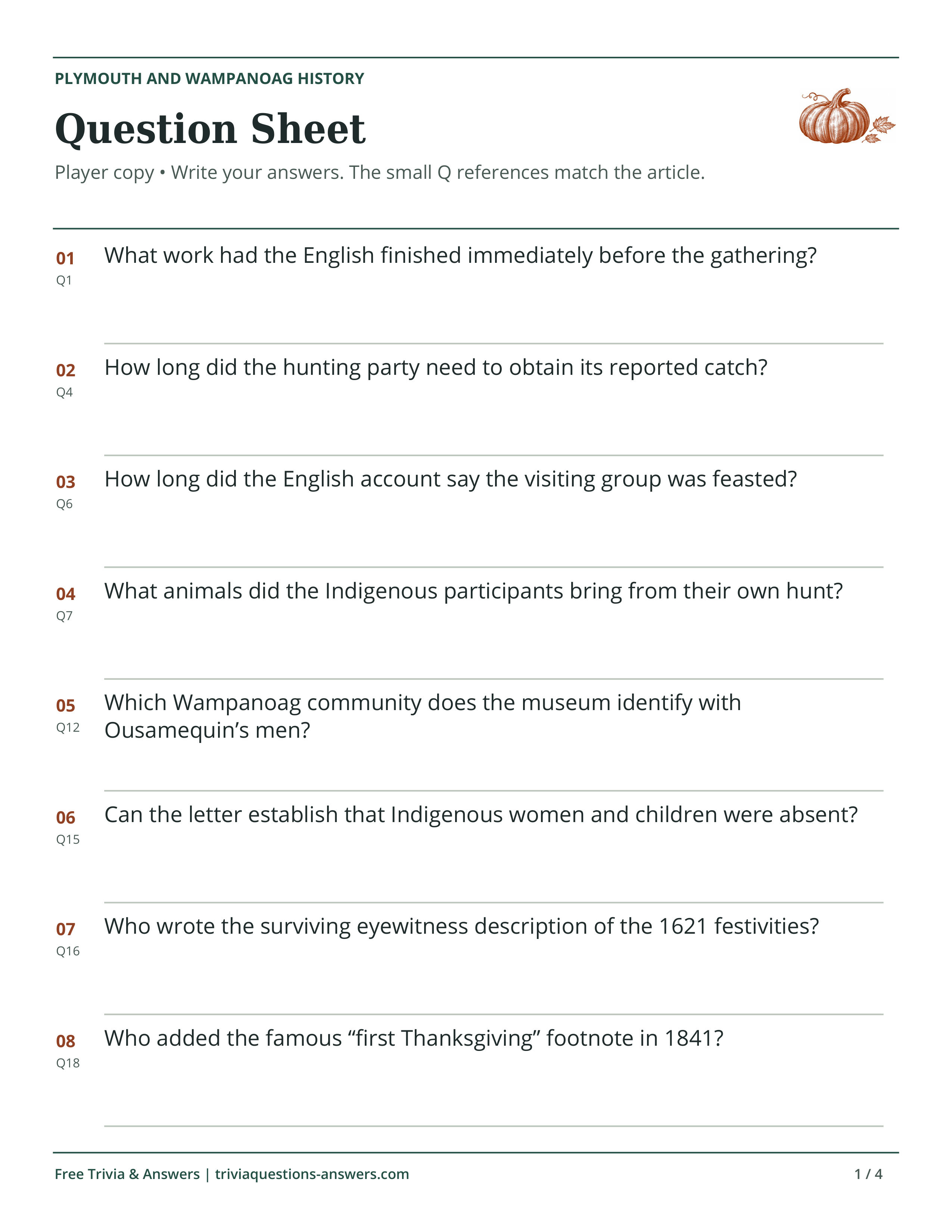
1. What work had the English finished immediately before the gathering?
Show Answer
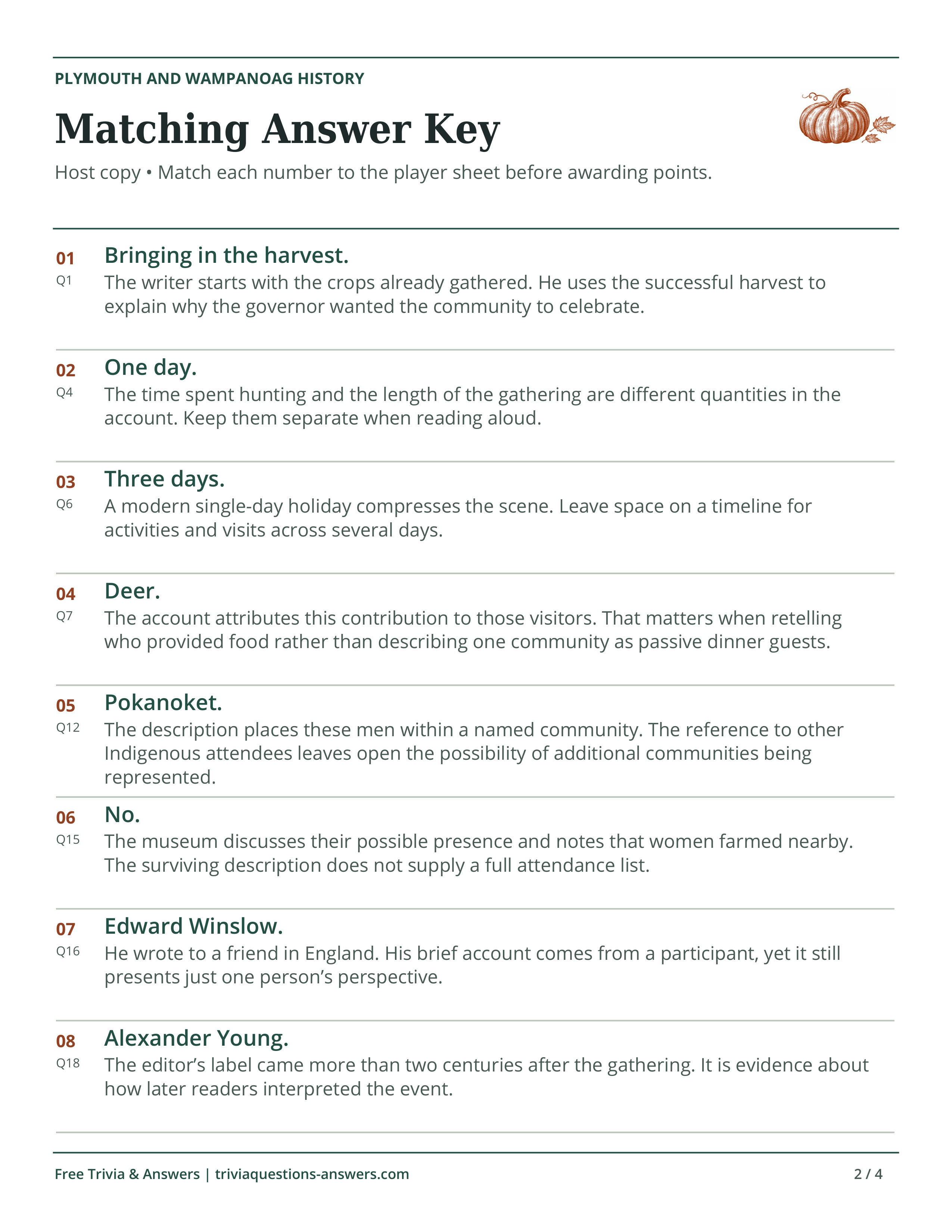
Bringing in the harvest. The writer starts with the crops already gathered. He uses the successful harvest to explain why the governor wanted the community to celebrate.
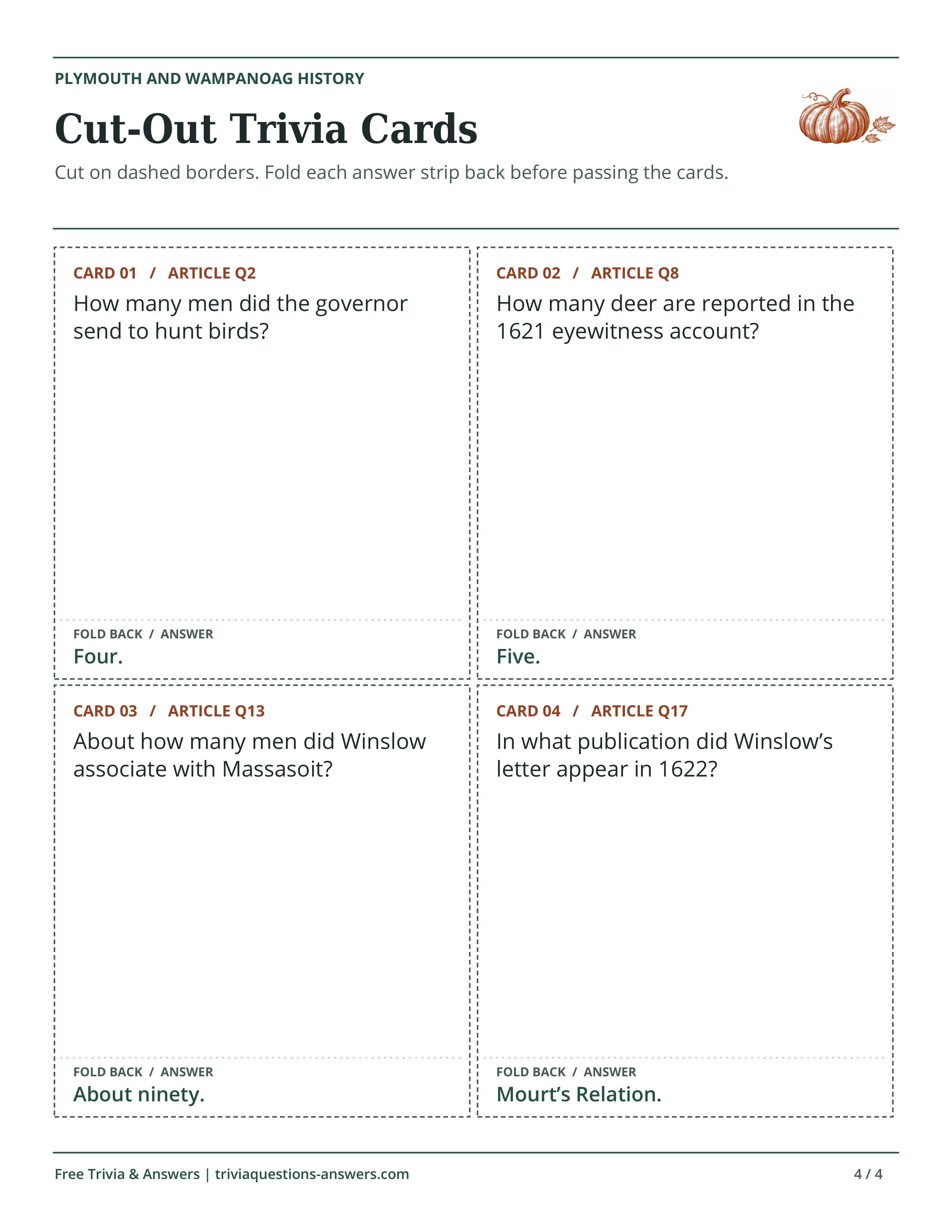
2. How many men did the governor send to hunt birds?
Show Answer
Four. The account gives the size of this particular hunting party. It does not give a similarly detailed accounting of every person who attended the festivities.
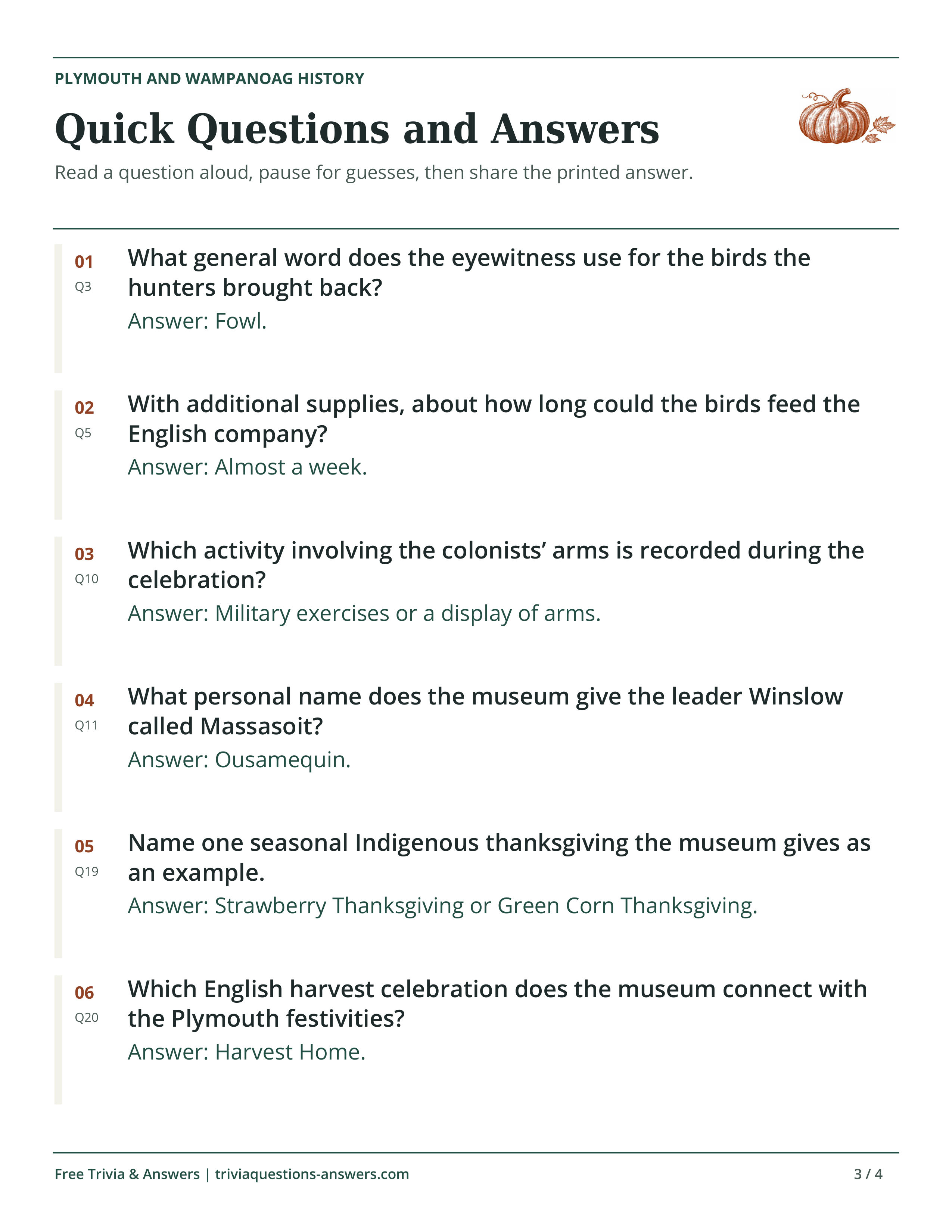
3. What general word does the eyewitness use for the birds the hunters brought back?
Show Answer
Fowl. That word covers birds more broadly than a single species. A confident claim that every bird served was a turkey goes beyond the passage.
4. How long did the hunting party need to obtain its reported catch?
Show Answer
One day. The time spent hunting and the length of the gathering are different quantities in the account. Keep them separate when reading aloud.
5. With additional supplies, about how long could the birds feed the English company?
Show Answer
Almost a week. The passage makes an estimate of how far food would stretch. It does not claim that the gathering itself lasted seven days.
6. How long did the English account say the visiting group was feasted?
Show Answer
Three days. A modern single-day holiday compresses the scene. Leave space on a timeline for activities and visits across several days.
7. What animals did the Indigenous participants bring from their own hunt?
Show Answer
Deer. The account attributes this contribution to those visitors. That matters when retelling who provided food rather than describing one community as passive dinner guests.
8. How many deer are reported in the 1621 eyewitness account?
Show Answer
Five. This is one of the story’s specific figures. Other foods often pictured on a modern holiday table receive no such confirmation in this passage.
9. Besides the governor, which officeholder does the letter specifically mention receiving deer?
Show Answer
The captain. The writer also mentions other recipients without naming them. His list describes gifts and their distribution rather than offering a complete menu.
10. Which activity involving the colonists’ arms is recorded during the celebration?
Show Answer
Military exercises or a display of arms. The description is brief. It does not establish the rules of a sports match or the motives of everyone who watched.
People, Diplomacy and Evidence
11. What personal name does the museum give the leader Winslow called Massasoit?
Show Answer
Ousamequin. Both names can appear in accounts of the same gathering. Identifying him by name helps keep the discussion grounded in a particular leader and community.
12. Which Wampanoag community does the museum identify with Ousamequin’s men?
Show Answer
Pokanoket. The description places these men within a named community. The reference to other Indigenous attendees leaves open the possibility of additional communities being represented.
13. About how many men did Winslow associate with Massasoit?
Show Answer
About ninety. Treat the figure as an approximation. It describes the group mentioned with the leader and cannot settle the gathering’s entire attendance.
14. Which relationship had brought several sachems to Plymouth shortly before the harvest celebration?
Show Answer
Diplomatic talks and treaty agreements. The museum places the gathering near these other meetings, giving readers reason to consider political relationships along with hospitality and food.
15. Can the letter establish that Indigenous women and children were absent?
Show Answer
No. The museum discusses their possible presence and notes that women farmed nearby. The surviving description does not supply a full attendance list.
16. Who wrote the surviving eyewitness description of the 1621 festivities?
Show Answer
Edward Winslow. He wrote to a friend in England. His brief account comes from a participant, yet it still presents just one person’s perspective.
17. In what publication did Winslow’s letter appear in 1622?
Show Answer
Mourt’s Relation. The publication helped introduce the colony to readers across the Atlantic. The letter’s date of composition and the date it appeared in print differ.
18. Who added the famous “first Thanksgiving” footnote in 1841?
Show Answer
Alexander Young. The editor’s label came more than two centuries after the gathering. It is evidence about how later readers interpreted the event.
Earlier Ways of Giving Thanks
19. Name one seasonal Indigenous thanksgiving the museum gives as an example.
Show Answer
Strawberry Thanksgiving or Green Corn Thanksgiving. Both examples precede the arrival of the colonists. They explain why an unrestricted claim about the continent’s first act of thanksgiving is misleading.
20. Which English harvest celebration does the museum connect with the Plymouth festivities?
Show Answer
Harvest Home. The museum distinguishes a harvest celebration from an English religious day proclaimed in response to a particular blessing. Both practices help explain seventeenth-century language.
Read an Eyewitness Carefully
Give each player two index cards labeled “The letter says” and “A historian suggests.” After answering a question, hold up the card that best describes the explanation. When the writer names an animal or gives a number, you can usually point to the words that settle the matter. When a historian puts forward a reason someone might have attended, listen for language that leaves room for evidence still to be found.
What the Name Leaves Out
The name of a holiday familiar to readers today can make a complicated encounter sound inevitable. Here, one English participant wrote a short account for someone far away. The writer had his own audience and purpose. A guest from another community could have remembered different parts of those same three days. A missing detail in this letter tells us what is missing from this letter. It cannot establish that a person, dish or idea was absent from the gathering.
How to Score an Uncertain Answer
For a classroom round, put three headings on the board: people, activities and unanswered questions. Award one point for an answer and a second when a team puts it under a defensible heading. Before you reveal the key, invite one group to ask a question the document cannot settle. A specific question about an unrecorded participant or the reasons for a visit shows closer reading than a confident guess about a familiar holiday scene.
Printable Sheets and Answer Materials
The PDF uses 18 of the 20 article questions. It includes an 8-question player sheet, a matching host key, a quick-read round, and four fold-back cards.
Use US Letter paper (8.5 × 11 inches) and print single-sided at actual size. Use the PDF page range to select individual sheets. If the PDF opens in your browser, use its download or print control.