Thanksgiving facts and trivia can begin with a single object. A chair leg can settle a question about a ship. A recipe card can document an invention. Read the fact groups as four short features, then let someone who has been listening try the recall questions.
Thirty Facts to Share
A Table Before the Photographs
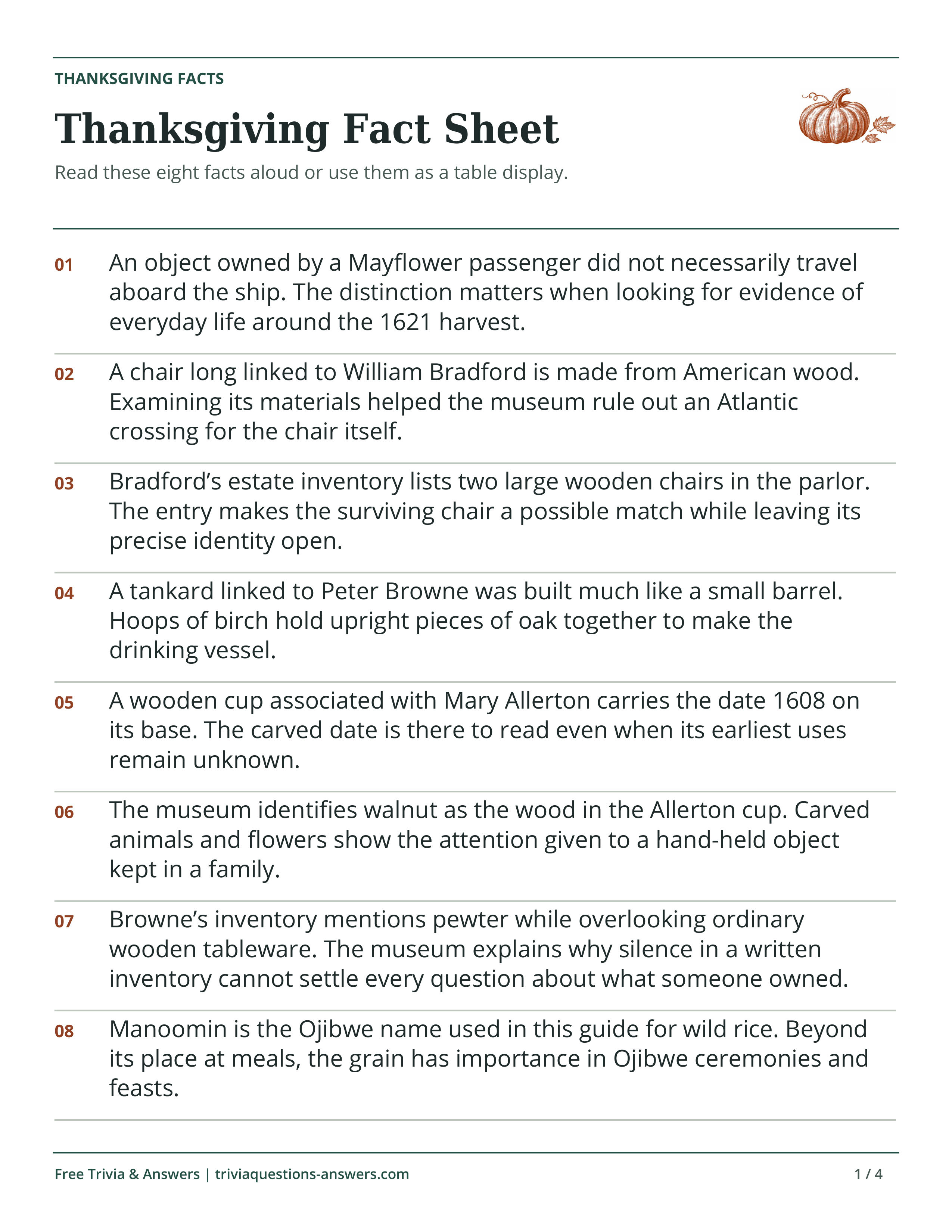
- An object owned by a Mayflower passenger did not necessarily travel aboard the ship. The distinction matters when looking for evidence of everyday life around the 1621 harvest.
- A chair long linked to William Bradford is made from American wood. Examining its materials helped the museum rule out an Atlantic crossing for the chair itself.
- Bradford’s estate inventory lists two large wooden chairs in the parlor. The entry makes the surviving chair a possible match while leaving its precise identity open.
- A tankard linked to Peter Browne was built much like a small barrel. Hoops of birch hold upright pieces of oak together to make the drinking vessel.
- A wooden cup associated with Mary Allerton carries the date 1608 on its base. The carved date is there to read even when its earliest uses remain unknown.
- The museum identifies walnut as the wood in the Allerton cup. Carved animals and flowers show the attention given to a hand-held object kept in a family.
- Browne’s inventory mentions pewter while overlooking ordinary wooden tableware. The museum explains why silence in a written inventory cannot settle every question about what someone owned.
A Harvest Behind a Side Dish
- Manoomin is the Ojibwe name used in this guide for wild rice. Beyond its place at meals, the grain has importance in Ojibwe ceremonies and feasts.
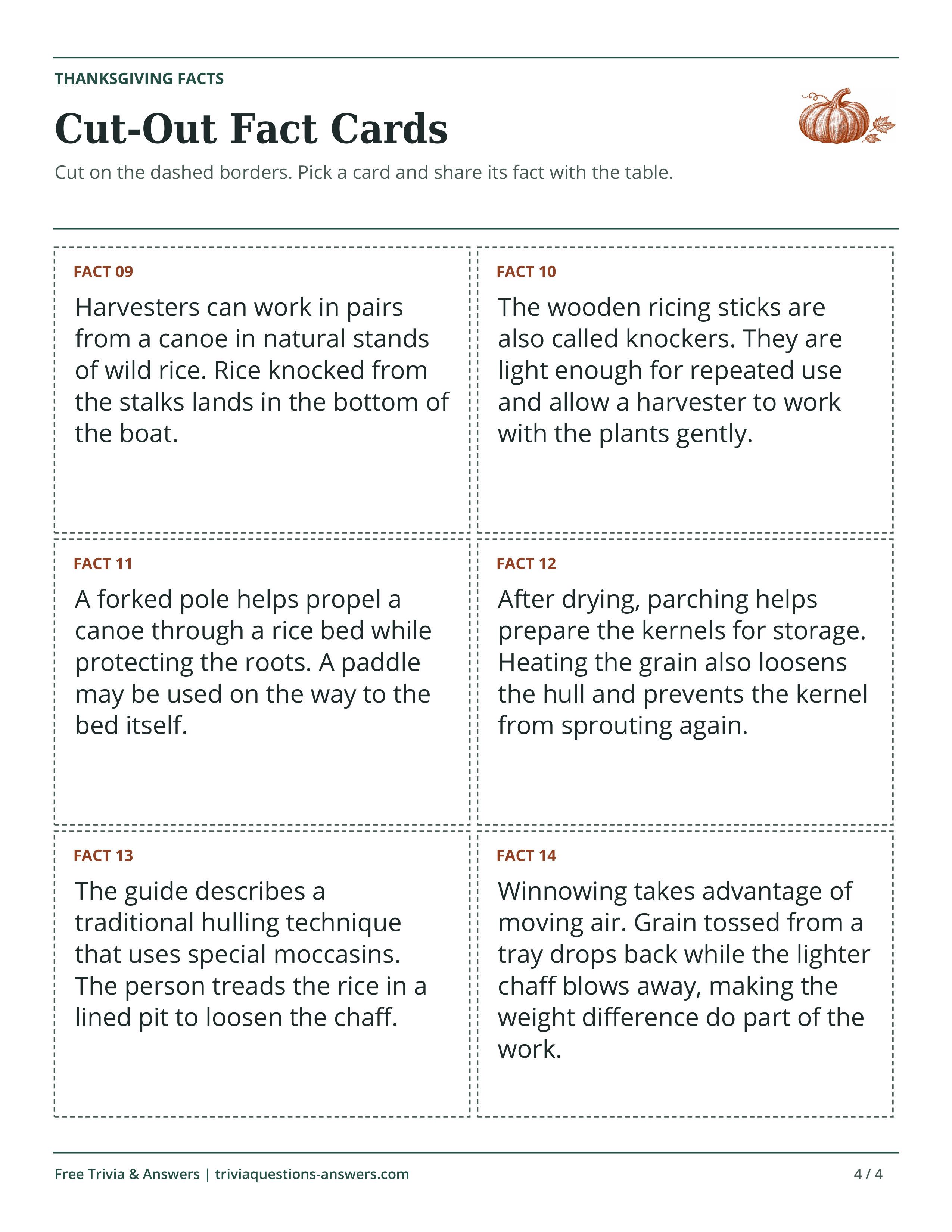
- Harvesters can work in pairs from a canoe in natural stands of wild rice. Rice knocked from the stalks lands in the bottom of the boat.
- The wooden ricing sticks are also called knockers. They are light enough for repeated use and allow a harvester to work with the plants gently.
- A forked pole helps propel a canoe through a rice bed while protecting the roots. A paddle may be used on the way to the bed itself.
- After drying, parching helps prepare the kernels for storage. Heating the grain also loosens the hull and prevents the kernel from sprouting again.
- The guide describes a traditional hulling technique that uses special moccasins. The person treads the rice in a lined pit to loosen the chaff.
- Winnowing takes advantage of moving air. Grain tossed from a tray drops back while the lighter chaff blows away, making the weight difference do part of the work.
- Commercial paddy-grown wild rice and hand-harvested rice from natural waters can look and cook differently. A recipe calling for wild rice alone does not tell you its harvest method.
Ink, Paper, and a Holiday Menu
- A New York bookseller, Isadore Warshaw, collected examples of American commercial life. Thanksgiving material makes up one small portion of the collection preserved by the Smithsonian.
- The Smithsonian finding aid identifies 1834 through 1914 as the date range for Warshaw’s Thanksgiving category. The material spans decades of changes in the holiday’s public image.
- The archive files Thanksgiving among the subject categories of its business ephemera. Objects printed for short-term use can outlast the businesses and seasonal events that produced them.
- Campbell gave Dorcas Reilly’s original green bean casserole recipe card to the National Inventors Hall of Fame in 2002. A piece of working kitchen paperwork became a record of invention.
- Artist Paul Rogers looked to mid-twentieth-century American posters and advertising for the 2009 parade stamp artwork. Older commercial art helped shape a newer holiday image.
- Rogers combined airbrush work with digital techniques on the parade stamps. A single printed design can have both handmade and computer-assisted steps.
- The Postal Service issued the 2009 designs on self-adhesive panes of twenty. The number of stamps on a pane was different from the number of distinct scenes.
- The Postal Service reported a printing of forty million for its 2009 parade stamps. A small illustration could travel on a striking number of individual letters.
Who Makes the Parade Fly?
- Computer renderings let designers rotate a balloon character before cutting fabric. A character that looks right on a screen also needs to travel at a workable angle outdoors.
- Crews join pieces of balloon fabric by applying heat. The giant figure takes shape from separate parts spread out in a workspace before its first inflation.
- A large character can contain several individually monitored chambers. The apparent single balloon can therefore be a set of smaller systems working together.
- The design team can put different amounts of air and helium into chambers to manage a balloon’s angle. Looking balanced is part of making the figure fly as intended.
- Macy’s builds and refurbishes floats and balloons in New Jersey for its New York parade. What happens in the studio is as much a part of the event as the march itself.
- Finished balloons undergo both indoor and outdoor test flights. Each setting gives the team different opportunities to check a design before parade day.
- The flight management team monitors details including balloon height and tension on the handlers’ lines. A spectator looking up at a character sees the result of work happening at street level.
Objects and Their Owners
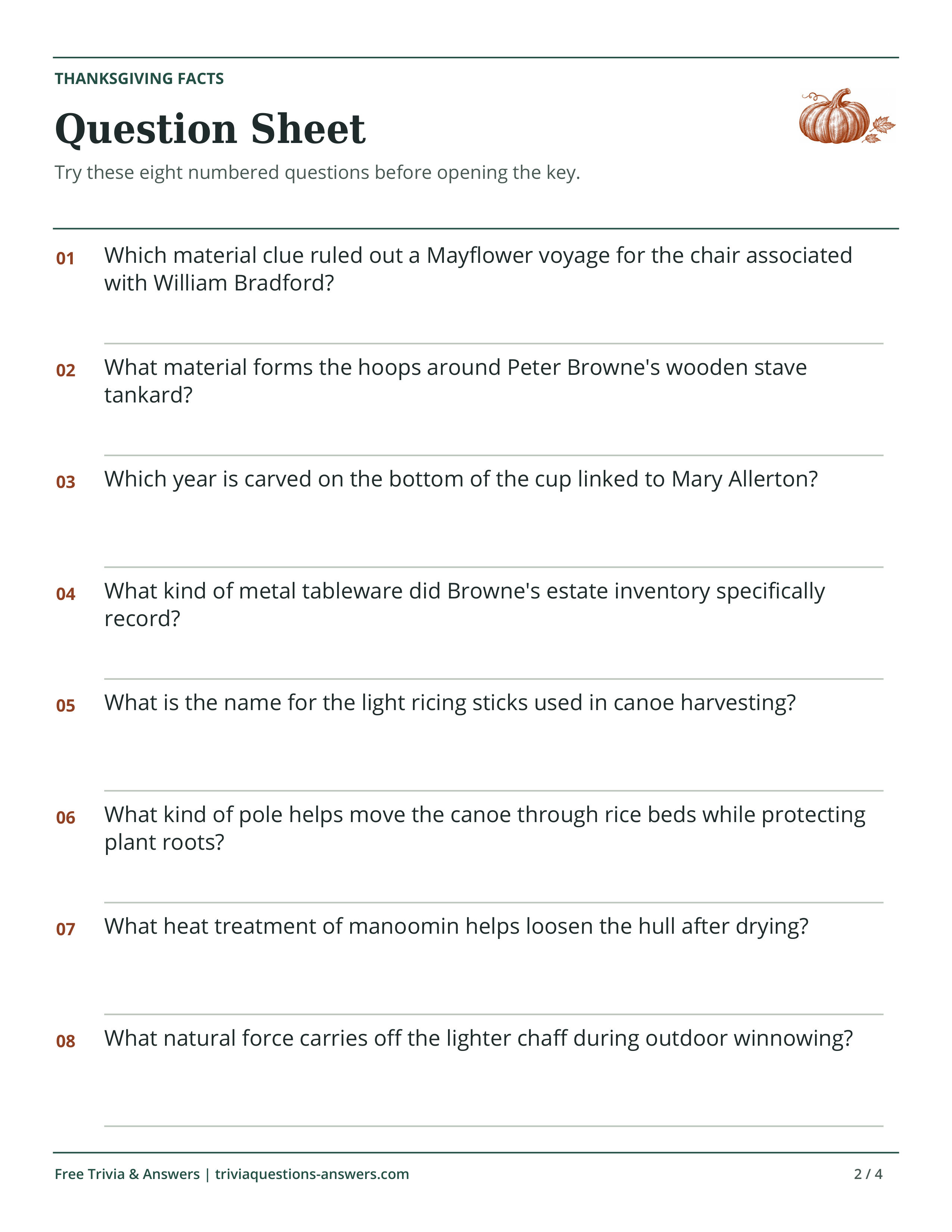
1. Which material clue ruled out a Mayflower voyage for the chair associated with William Bradford?
Show Answer
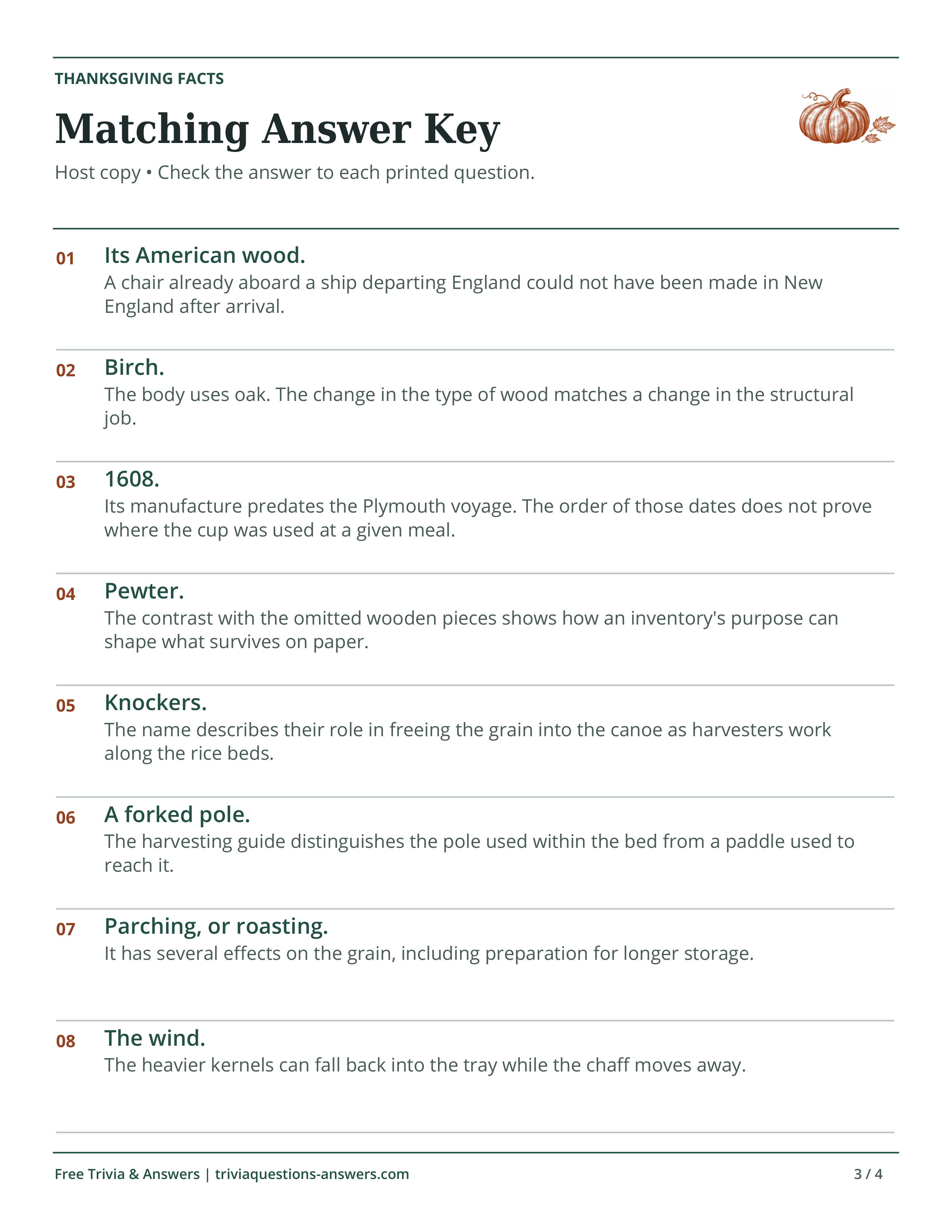
Its American wood. A chair already aboard a ship departing England could not have been made in New England after arrival.
2. What material forms the hoops around Peter Browne's wooden stave tankard?
Show Answer
Birch. The body uses oak. The change in the type of wood matches a change in the structural job.
3. Which year is carved on the bottom of the cup linked to Mary Allerton?
Show Answer
1608. Its manufacture predates the Plymouth voyage. The order of those dates does not prove where the cup was used at a given meal.
4. What kind of metal tableware did Browne's estate inventory specifically record?
Show Answer
Pewter. The contrast with the omitted wooden pieces shows how an inventory's purpose can shape what survives on paper.
The Wild Rice Harvest
5. What is the name for the light ricing sticks used in canoe harvesting?
Show Answer
Knockers. The name describes their role in freeing the grain into the canoe as harvesters work along the rice beds.
6. What kind of pole helps move the canoe through rice beds while protecting plant roots?
Show Answer
A forked pole. The harvesting guide distinguishes the pole used within the bed from a paddle used to reach it.
7. What heat treatment of manoomin helps loosen the hull after drying?
Show Answer
Parching, or roasting. It has several effects on the grain, including preparation for longer storage.
8. What natural force carries off the lighter chaff during outdoor winnowing?
Show Answer
The wind. The heavier kernels can fall back into the tray while the chaff moves away.
The Printed Holiday
9. What was collector Isadore Warshaw's trade?
Show Answer
He was a bookseller. His collection of commercial ephemera gives historians more than the lasting record of books alone.
10. Which institution received the original written green bean casserole recipe card from Campbell?
Show Answer
The National Inventors Hall of Fame. The donation treated a kitchen recipe as a record of a developer's work.
11. What traditional painting tool did Paul Rogers combine with digital work for the parade stamps?
Show Answer
An airbrush. The finished design drew on poster art, and its production mixed techniques from different eras.
12. How many individual parade stamps were in a 2009 self-adhesive pane?
Show Answer
Twenty. A pane repeats stamp designs. Counting individual stamps produces a larger answer than counting the designs.
The Working Parade
13. How do makers join the pieces of fabric in the parade balloons described by the museum?
Show Answer
With heat sealing. Separate pieces become one shaped assembly before crews test the inflated character.
14. Which two test environments do finished characters experience before the parade?
Show Answer
Indoor and outdoor test flights. Passing one first look indoors is only part of preparing a balloon for the street.
15. What does the flight team monitor in the handlers' lines besides the height of the figure?
Show Answer
Tension. The handlers on the ground and the team watching the balloon work on the same moving system.
Share a Fact with Its Evidence
Before reading a fact aloud, tell the table what kind of evidence it uses. For the drinking vessel, the material is part of the object; for the parade stamps, a postal announcement records how many were issued. Ask guests what kind of thing a future historian would need to answer a question about this year’s meal. A recipe card might identify ingredients, while a photograph might show who sat where. Neither can do all the work alone.
Printable Sheets and Answer Materials
The PDF includes 14 selected facts and an eight-question quiz with a separate key. The article contains the full fact collection.
Use US Letter paper (8.5 × 11 inches) and print single-sided at actual size. Use the PDF page range to select individual sheets. If the PDF opens in your browser, use its download or print control.
Sources and Further Reading
- pilgrimhall.org — Treasures of the Collection, Bradford chair and Browne tankard
- files.dnr.state.mn.us — Harvesting and Processing Manoomin, knocking, parching and winnowing
- sirismm.si.edu — Warshaw Thanksgiving finding aid, collector and collection overview
- thecampbellscompany.com — Campbell memorial, 2002 donation
- about.usps.com — USPS parade stamps, techniques and pane
- smithsonianmag.com — Air and Space Museum, design and test process
2 thoughts on “Thanksgiving Facts and Trivia: Fun Facts to Share”
Comments are closed.